Tag: Corrosion

  • Pitting Corrosion

    Pitting Corrosion

    Material Selection Guidelines for Mitigating the Risk

    Corrosion-resistant alloys rely on a passive chromium oxide film on their surface for protection against corrosion. However, exposure to chlorides or oxygen can destabilize this protective film. When this occurs, small areas on the surface become active, leading to rapid localized corrosion, also known as pitting corrosion. This process creates small, often undetectable, holes in the metal, which can result in catastrophic failure. Additionally, elevated temperatures and low pH levels further compromise the stability of the chromium oxide film.

    Improving Corrosion Resistance

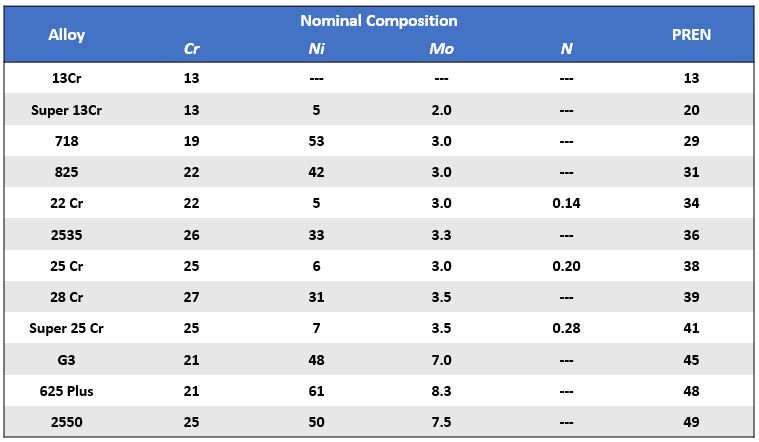
    Increasing the chromium content in the alloy or alloying it with molybdenum, tungsten, or nitrogen can enhance resistance to pitting corrosion. A widely used method for assessing the pitting resistance of corrosion-resistant alloys is the Pitting Resistance Equivalent Number (PREN), which is calculated through an empirical formula. PREN is a key metric in ranking the effectiveness of alloys against pitting corrosion. The most common form of this equation is:

    PREN = CRwt% + 3.3 x (Mowt% + 0.5 x Wwt%) + 16 x Nwt%

    Below is a comparison of PREN values for commonly used alloys in oil and gas well completions, particularly for OCTG corrosion applications.
    Improving Corrosion ResistanceRecommendations for Severe Conditions

    For environments where chloride content exceeds 100,000 ppm or oxygen content surpasses 10 ppb, using corrosion-resistant alloys with a high PREN is essential. Specifically, in conditions such as seawater exposure or risk of oxygen contamination, alloys with PREN values greater than 40 are recommended. This ensures maximum corrosion resistance and minimizes the risk of localized pitting corrosion.

    Stress Corrosion Cracking (SCC) Prevention

    Pitting corrosion and tensile stresses can act as a stress riser, triggering Stress Corrosion Cracking (SCC). Alloys with higher nickel content provide superior resistance against SCC, particularly in the presence of chlorides. Alloys containing over 42% nickel are widely regarded as immune to SCC caused by chlorides, making them an ideal choice for harsh environments.

    In Summary

    Selecting alloy materials with high PREN values and appropriate nickel content is critical for effectively mitigating pitting and OCTG corrosion in high-chloride or oxygen-containing environments. By adhering to these guidelines, industries such as oil and gas can ensure longer-lasting and more durable performance under extreme conditions.
  • CO2 & General Corrosion

    CO2 & General Corrosion

    And Chromium’s Role in Corrosion Protection

    Corrosion rates depend on various factors, including temperature, pH, flow rate, and oxygen or organic acids. CO2 corrosion is the most common cause of general corrosion in oil and gas production. When water is present, CO2 reacts to form carbonic acid, a highly corrosive agent. This becomes especially problematic in gas fields, where water condensation often occurs if the temperature drops below the dew point—an issue frequently observed during start-up or shut-in phases.

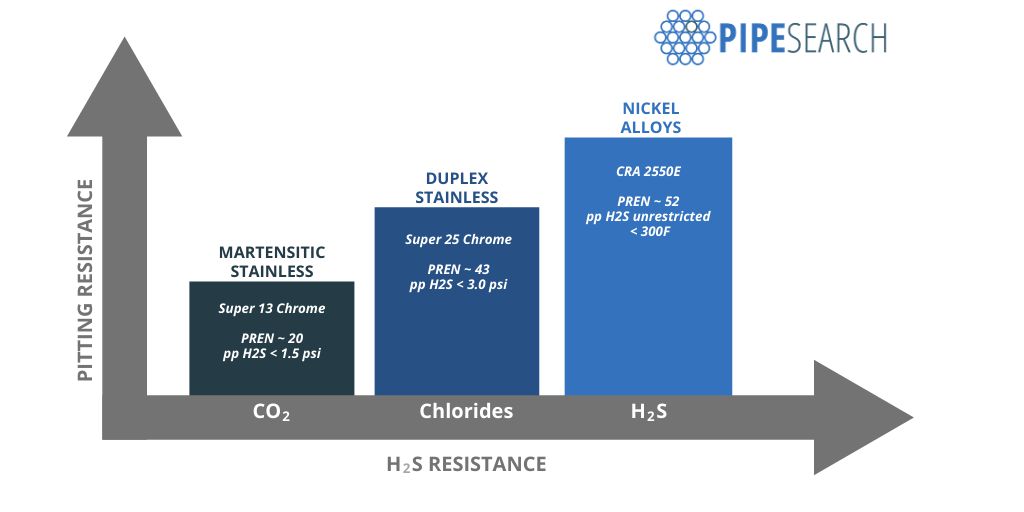
    Corrosion-resistant alloys (CRA OCTG) protect against corrosion through chromium content, forming a passive, protective layer. The higher the chromium content, the stronger the corrosion resistance. Martensitic stainless steels with 13% chromium can provide adequate protection for mild conditions. However, if the pH level drops below 3.5, higher-grade alloys, such as duplex stainless steels, are recommended.

    When considering materials for injection wells, it is critical to carefully model pH levels for current and anticipated conditions. Proper modeling is not recommended for using 13% chromium steel in such environments.

    Elevate your corrosion resistance by selecting the right alloy for your operational needs and ensuring long-term protection against CO2 corrosion.

  • Galvanic Corrosion in Oil & Gas Production: What You Need to Know

    Galvanic Corrosion in Oil & Gas Production: What You Need to Know

    What Is Galvanic Corrosion?

    Galvanic corrosion, also known as bimetallic corrosion, occurs when two dissimilar metals come into contact in the presence of an electrolyte. This electrochemical reaction is driven by the difference in electropotential between the metals, like the process within a battery.

    How Galvanic Corrosion Happens

    When galvanic corrosion occurs, ions migrate from the less noble metal (the anode) to the more noble metal (the cathode). However, for this process to take place, two conditions must be met:

    • Presence of an electrolyte
    • Electrical contact between the metals

    Packer or production fluids often serve as electrolytes within oil and gas production. Fluids with low conductivity, like oil-based packer fluids, pose minimal risk. However, water-based packer and acidizing fluids, which are stronger electrolytes, present a greater concern for galvanic corrosion.

    Factors Influencing Galvanic Corrosion

    Several factors impact the severity and likelihood of galvanic corrosion, particularly in systems involving nickel pipe, steel casing, or nickel casing.

    • Electropotential Difference: The greater the electropotential difference between two metals, the higher the corrosion rate in the anode. However, this isn’t solely determined by the metal alloy—it is also influenced by the surrounding environment, surface conditions, and protective films.
    • Surface Films and Scale: Corrosion inhibitors and natural surface films can act as insulators, reducing the risk of galvanic corrosion. For example, Nickel-based alloys and stainless steels often form passive surface films in oxidizing environments, preventing corrosion. However, under reducing conditions (e.g., during acidizing), these protective films may break down, increasing the risk of accelerated galvanic corrosion.
    • Cathode-to-Anode Surface Area Ratio: A high ratio of cathode surface area to anode surface area can accelerate corrosion at the anode. This effect is critical to consider in the design and maintenance of oil and gas production equipment.

    Why Galvanic Corrosion Is a Concern in Oil & Gas Production

    Different metals are common in oil and gas systems, creating frequent opportunities for galvanic corrosion. Here are some key examples:

    • Mixed tubing strings
    • Nickel pipe or nickel casing components in contact with steel casing
    • Nickel alloy accessories used alongside stainless steel tubing

    Prolonged exposure to harsh conditions like water-based packer fluids or acidizing environments can further heighten the risk of galvanic corrosion, leading to equipment degradation and increased maintenance costs.

    By understanding how galvanic corrosion develops, its influencing factors, and common scenarios in oil and gas production, operators can take preventative measures, such as using corrosion inhibitors and selecting the right materials to extend the longevity of equipment.